
You’re scrolling through homes for sale on your phone, and one catches your attention. It has the right layout, a great kitchen, and maybe even the neighborhood you want.
Then you see the asking price—or calculate the estimated monthly payment—and close the app.
Even when you love the house, the numbers may feel out of reach. But before you assume buying isn’t possible, there’s something important happening in today’s housing market.
Nationally, there are more homes available than there are buyers actively looking. When sellers need buyers more than buyers need sellers, it eventually shows up in the asking price.
We’re seeing:
More price reductions
More realistic initial asking prices
Greater flexibility during negotiations
More sellers willing to help buyers make the numbers work
That could make buying a home more manageable than you may think.
One of the clearest indications that sellers are adjusting to today’s market is the growing number of price reductions.
According to HousingWire Data, more than 40% of sellers have reduced their asking price. That’s only slightly below the level recorded last year.
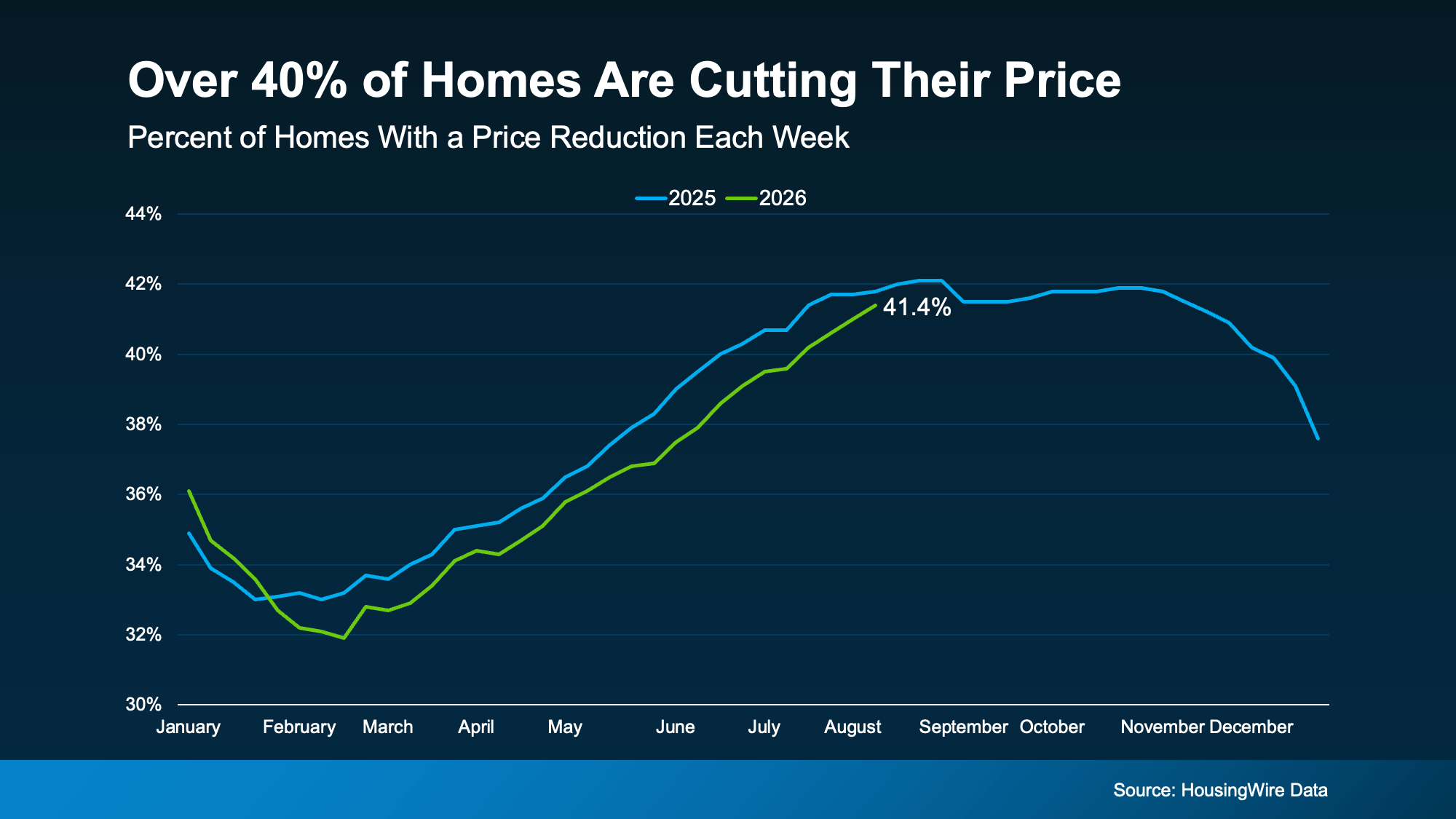
Think about what that means. More than four out of every ten listed homes have experienced a price reduction.
Those sellers have decided they would rather adjust their price and attract a serious buyer than continue waiting for someone willing to pay more than the market will support.
We’ve always told our sellers that the market ultimately determines what a home is worth. A seller can choose any asking price, but buyers decide whether that price makes sense.
When buyers aren’t scheduling showings or submitting offers, the most effective adjustment a seller can make is usually the price.
As Danielle Hale, Chief Economist at Realtor.com, explains:
“This is a market where people are adjusting and showing up rather than giving up. Sellers are meeting the market with more realistic asking prices, which is helping deals get done.”
What about the other six out of ten sellers who haven’t reduced their price?
Many of them may have started with a more realistic asking price instead of listing high and waiting to see what would happen.
According to Realtor.com, July 2026 had the lowest median list price for any July during the past five years.
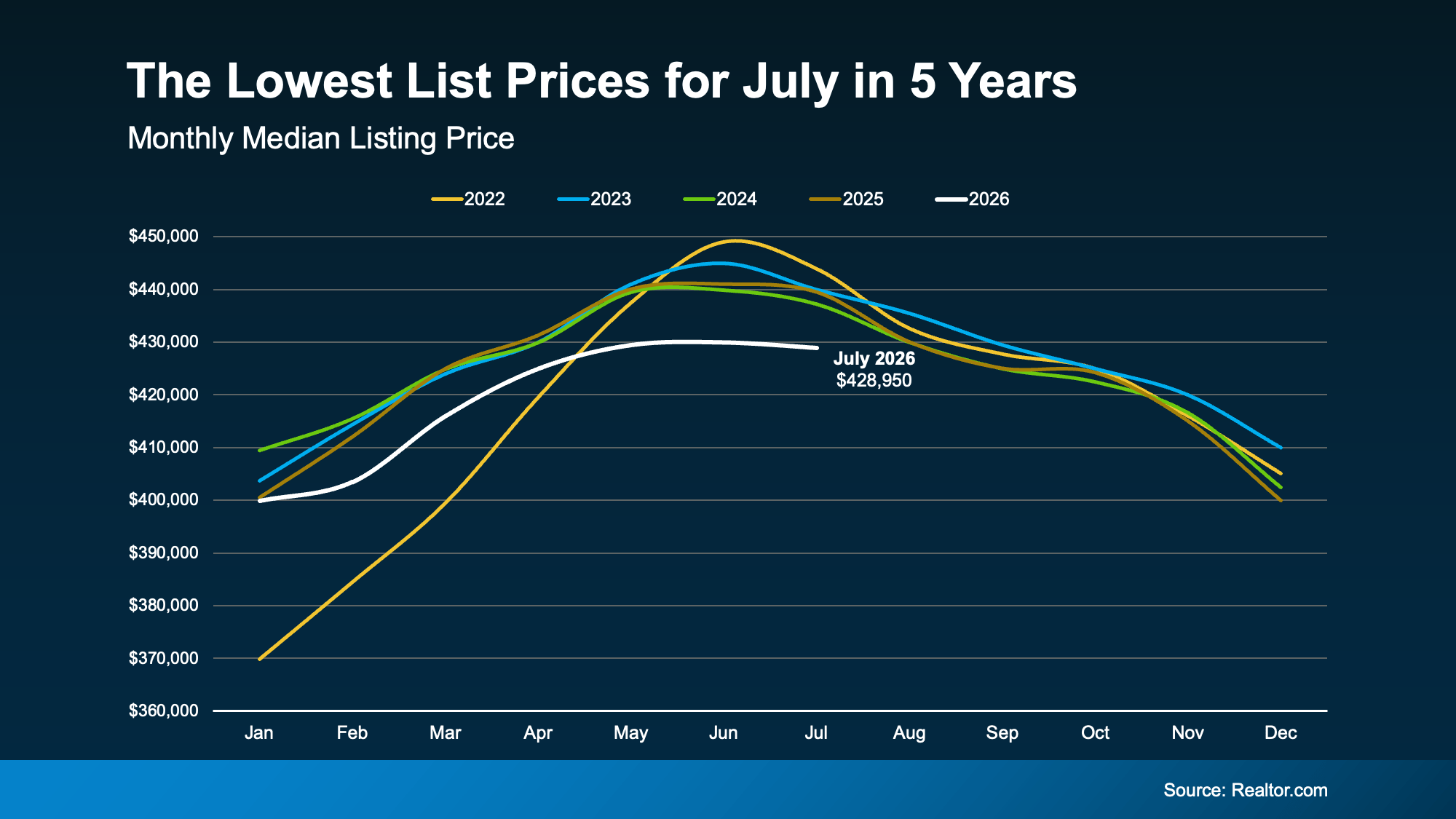
That doesn’t mean home values are collapsing or that every property is suddenly a bargain. Home prices remain considerably higher than they were before the pandemic.
What it does mean is that sellers are becoming more realistic.
Many sellers are no longer assuming they’ll receive multiple offers or that buyers will pay whatever price they choose. Instead, they’re looking carefully at recent sales, competing homes, current inventory, and what buyers can reasonably afford.
Whether a seller prices correctly from the beginning or reduces the price after several weeks on the market, the message for buyers is the same:
Sellers are becoming more willing to meet buyers where they are.
During the extremely competitive market of a few years ago, buyers frequently had to compete against multiple offers, waive protections, and offer more than the asking price.
Today’s market is different.
Depending on the home, its condition, its location, and how long it has been listed, buyers may be able to negotiate more than just the purchase price.
A seller may also be willing to consider:
Paying some of the buyer’s closing costs
Providing funds for an interest-rate buydown
Completing requested repairs
Offering an allowance for carpet, paint, or other updates
Accepting an offer contingent upon the buyer selling a current home
Agreeing to a more flexible closing or possession date
Not every seller will agree to every request. But buyers often have more opportunities to negotiate than they realize.
Here in Parker and the surrounding communities, every neighborhood and price range can behave differently. A beautifully updated home in a desirable location may still attract strong interest, while an overpriced or dated home may sit on the market and eventually require a substantial adjustment.
That’s why it’s important to look beyond the asking price and understand the complete situation.
Affordability remains a genuine concern. The monthly payment matters, and no buyer should take on a payment that makes them uncomfortable.
But if you’ve been assuming every home is beyond your budget, it may be worth taking another look.
A home listed slightly above your preferred price range may have been sitting on the market for several weeks. The seller may already be considering a reduction—or may be willing to negotiate an offer that includes closing costs or an interest-rate buydown.
The answer is always “no” if you never ask.
Our job as your buyer’s agents is to research the property, study the comparable sales, evaluate the seller’s position, and help you prepare an offer that protects your interests while still giving you a reasonable opportunity to get the house.
Price reductions are also an important reminder for homeowners considering selling.
Starting too high can cost you valuable time and buyer interest. The greatest exposure often occurs during the first few weeks after a home enters the market. If buyers believe the property is overpriced, they may simply skip it and move on to another home.
By the time the price is reduced, those buyers may already be under contract somewhere else.
Pricing a home correctly doesn’t mean giving it away. It means positioning it to attract the greatest number of qualified buyers and generate the strongest possible response.
Sellers are showing more flexibility than they did during the highly competitive market of a few years ago. Some are reducing their prices, while others are beginning with more realistic expectations.
For buyers, that may create opportunities to negotiate the price, closing costs, repairs, or an interest-rate buydown.
You may be surprised by what’s currently available—and by how willing some sellers are to work with a serious, well-qualified buyer.
If you’re considering buying a home in Parker, Castle Rock, Franktown, Elizabeth, Highlands Ranch, Centennial, Aurora, or another nearby community, contact the Parker Colorado Home Center. We’ll help you understand the market, identify the best opportunities, and determine how much negotiating room may exist.
Sometimes the home that looks just beyond your budget may be more attainable than you think.

If 2026 has felt stressful to you, you’re certainly not alone. A recent survey from Talker Research asked Americans to choose one word to describe the year so far. The most common answer was “stressful.”
With so much uncertainty in the news, it’s understandable that some people are postponing their plans to buy or sell a home. They’re waiting for things to settle down before making such an important decision.
But when it comes to housing, the market may already be more stable than you realize.
Despite headlines that continue to raise concerns about a possible housing crash, the actual numbers tell a much calmer story.
Following several years of unusually rapid appreciation, home-price growth has slowed considerably.
According to data from the National Association of Realtors, national home prices have remained remarkably steady over the past four years.
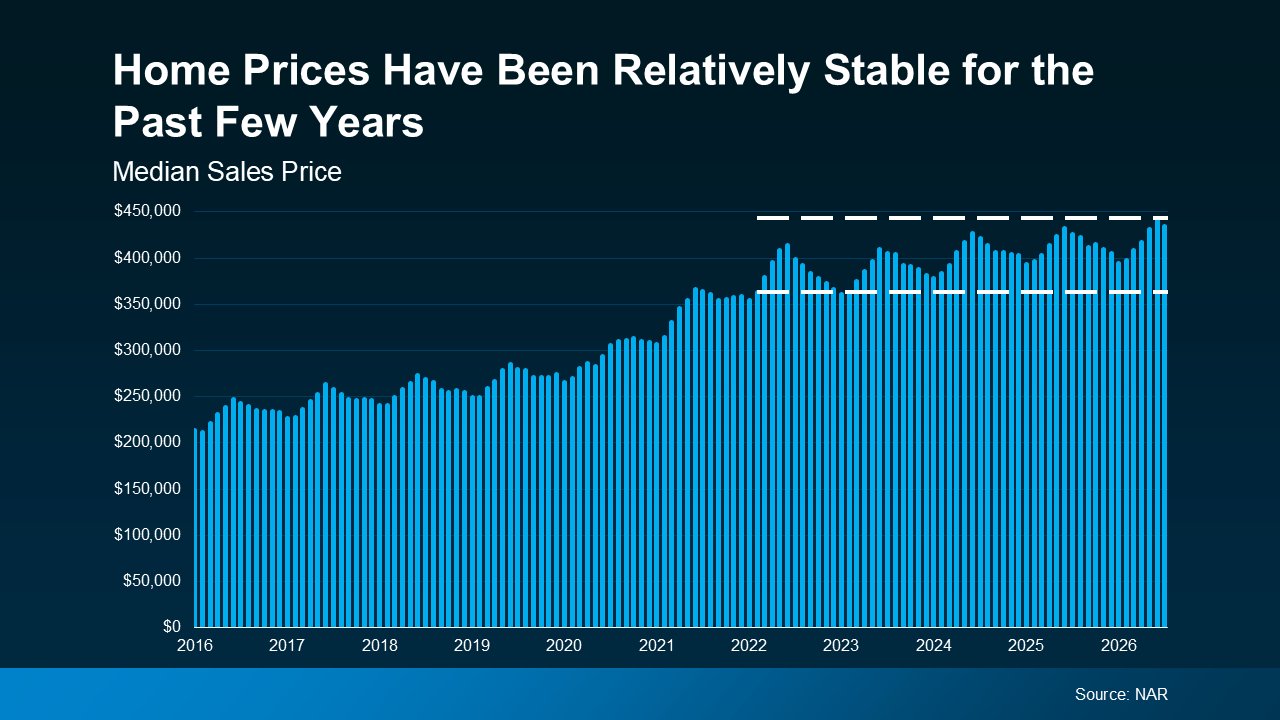
That is not what a housing crash looks like.
Instead of experiencing dramatic increases or widespread declines, the national housing market has moved into a period of slower, more sustainable growth.
Selma Hepp, Chief Economist at Cotality, explains:
“In 2026, we expect home prices to remain broadly stable, with modest appreciation at a national level.”
That kind of stability is generally a sign of a healthier and more balanced housing market.
Of course, real estate is always local. Home values can behave differently from one city, price range, and neighborhood to another. Here in Parker and throughout the Denver metro area, buyers and sellers need to look at current local sales—not just national headlines—to understand what is happening.
Housing inventory changed dramatically during and immediately after the pandemic. The number of available homes fell to extremely low levels and then gradually began recovering.
Now, according to Realtor.com, the number of homes for sale nationally is very close to where it was at this time last year.
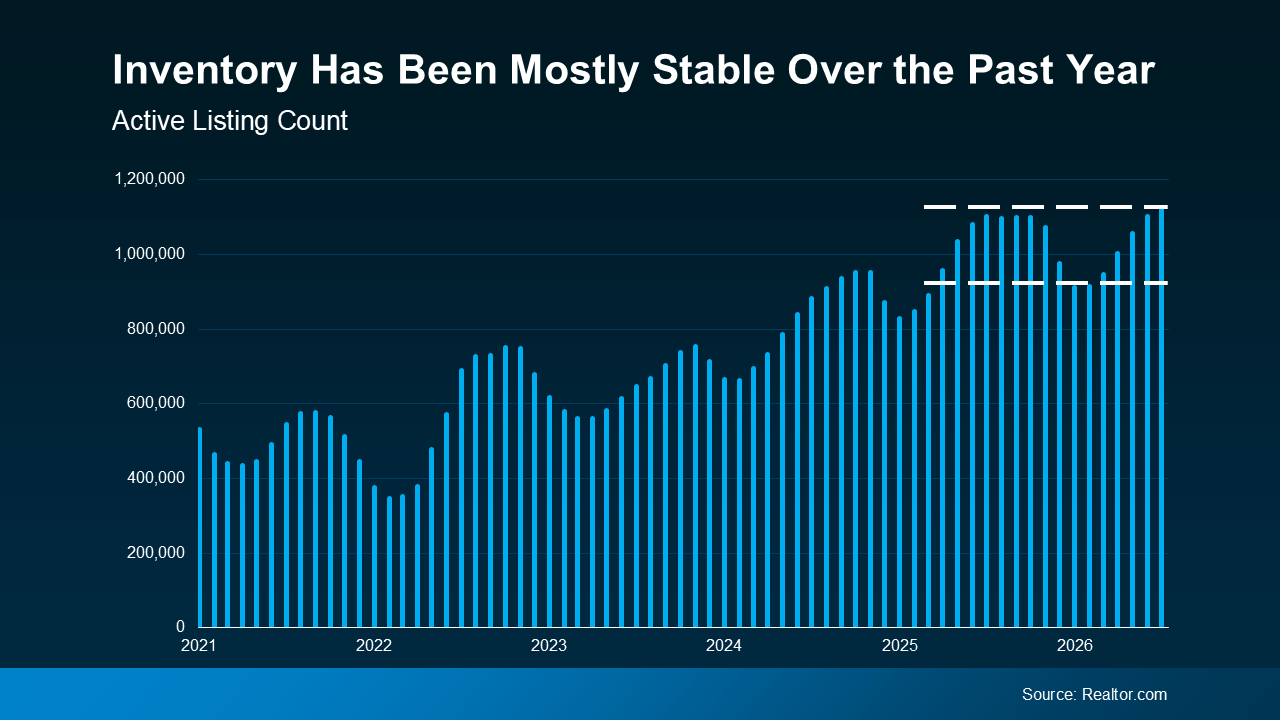
A steadier supply of homes gives both buyers and sellers a clearer idea of what to expect.
Buyers may have more choices and more time to make careful decisions than they did during the highly competitive pandemic market. Sellers, meanwhile, have a better understanding of how much competition they may face and why accurate pricing, condition, presentation, and marketing are so important.
This doesn’t mean every home will sell quickly or that every buyer will have unlimited negotiating power. It means the market is becoming more predictable—and that is good for everyone.
There’s no question that mortgage rates increased dramatically in 2022. That sudden change affected affordability and caused many buyers and sellers to reconsider their plans.
Since then, however, rates have generally remained within a more consistent range. Data from Freddie Mac shows that mortgage rates have stayed mostly between 6% and 7% for approximately the past three years.
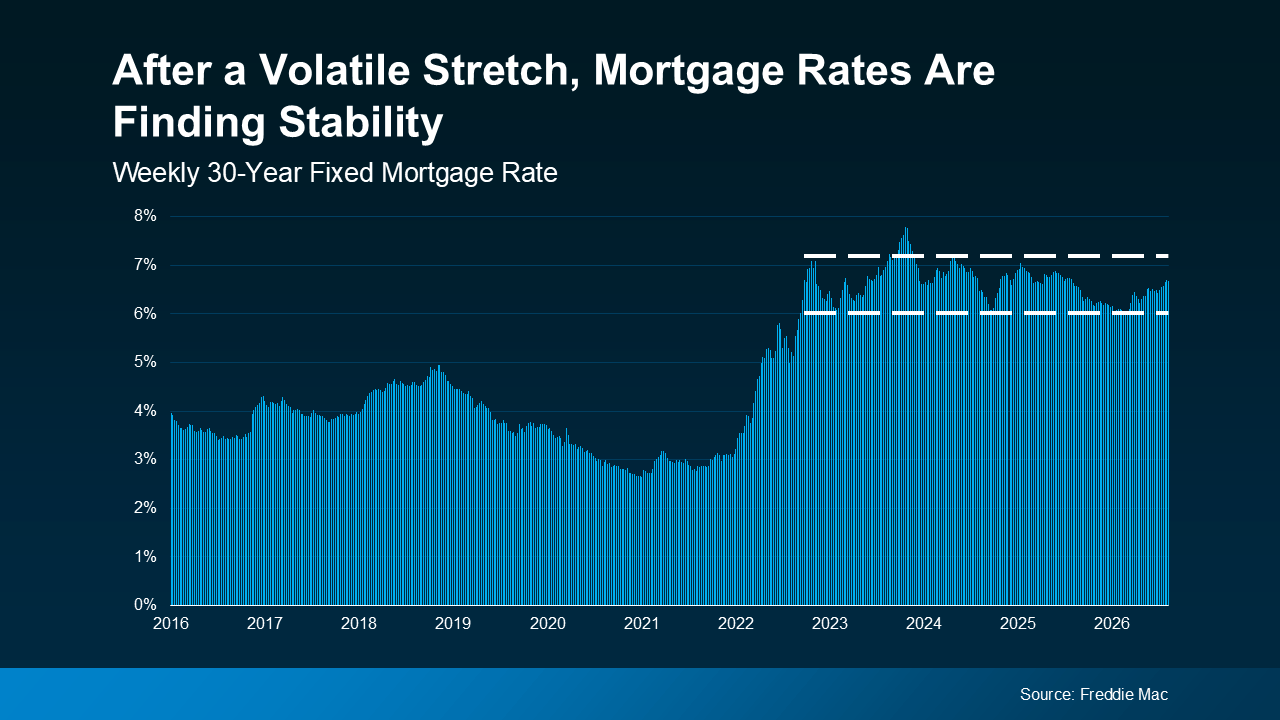
There was a brief period when rates moved above that range, but overall, the market has had time to adjust.
Buyers are learning how to purchase homes in today’s interest-rate environment, sometimes using rate buydowns, adjustable-rate mortgages, larger down payments, or seller concessions to improve affordability.
Sellers are adjusting too. Many understand that today’s buyers are payment-conscious and that a home must be priced correctly to attract serious attention.
The important point is that the housing market is not frozen. People are still buying and selling homes because families continue to grow, jobs change, retirees downsize, and people relocate to be closer to children and grandchildren. Life doesn’t always wait for the “perfect” market.
Many people hear the words “housing slowdown” and immediately think about 2008. But today’s market is fundamentally different.
Most homeowners have substantial equity, lending standards are considerably stronger, and the country does not have the same combination of risky mortgages, excessive overbuilding, and distressed properties that contributed to the last housing crash.
Today’s market certainly has challenges, but slower sales and more balanced conditions do not automatically signal a crash. In many cases, they simply indicate that the market is returning to a more normal pace.
The world may feel unpredictable, but the housing market is more stable than many headlines suggest. Home prices have leveled out, inventory has steadied, and mortgage rates have remained within a relatively consistent range.
That doesn’t mean every home will increase in value or that every local market will perform exactly the same. It does mean the numbers do not support the idea that a nationwide housing crash is right around the corner.
If you’ve been waiting for greater stability before buying or selling, it may already be here.
At the Parker Colorado Home Center, we can help you understand exactly what is happening in Parker, Castle Rock, Franktown, Elizabeth, Highlands Ranch, Centennial, Aurora, or your particular neighborhood. Contact Bob and Cheryl Bustin, and let’s talk through your situation, your timing, and whether making a move now makes sense for you.
When was the last time you received a professional opinion of what your home is actually worth?
We’re not talking about an estimate generated by an online valuation tool—or assuming your home is worth the same as a neighbor’s property that recently sold. We’re talking about a careful, market-based evaluation of what your particular home could sell for in today’s market.
For many homeowners, it has been years since they’ve had that conversation. And if you’ve thought about moving but higher home prices or today’s mortgage rates have caused you to hesitate, it may be time to take another look.
The number that could change everything is the amount of equity you have in your home.
Home values have increased considerably over the past five to ten years. Even though today’s real estate market is more balanced than it was a few years ago, many homeowners are still building wealth simply by owning their homes.
Equity generally grows in two ways:
Your home increases in value.
You reduce your mortgage balance through your monthly payments.
Over time, those two things can add up to a substantial amount of money.
According to Cotality, the typical homeowner with a mortgage now has approximately $310,500 in equity. That is a national average, and homeowners in some states have built considerably more.
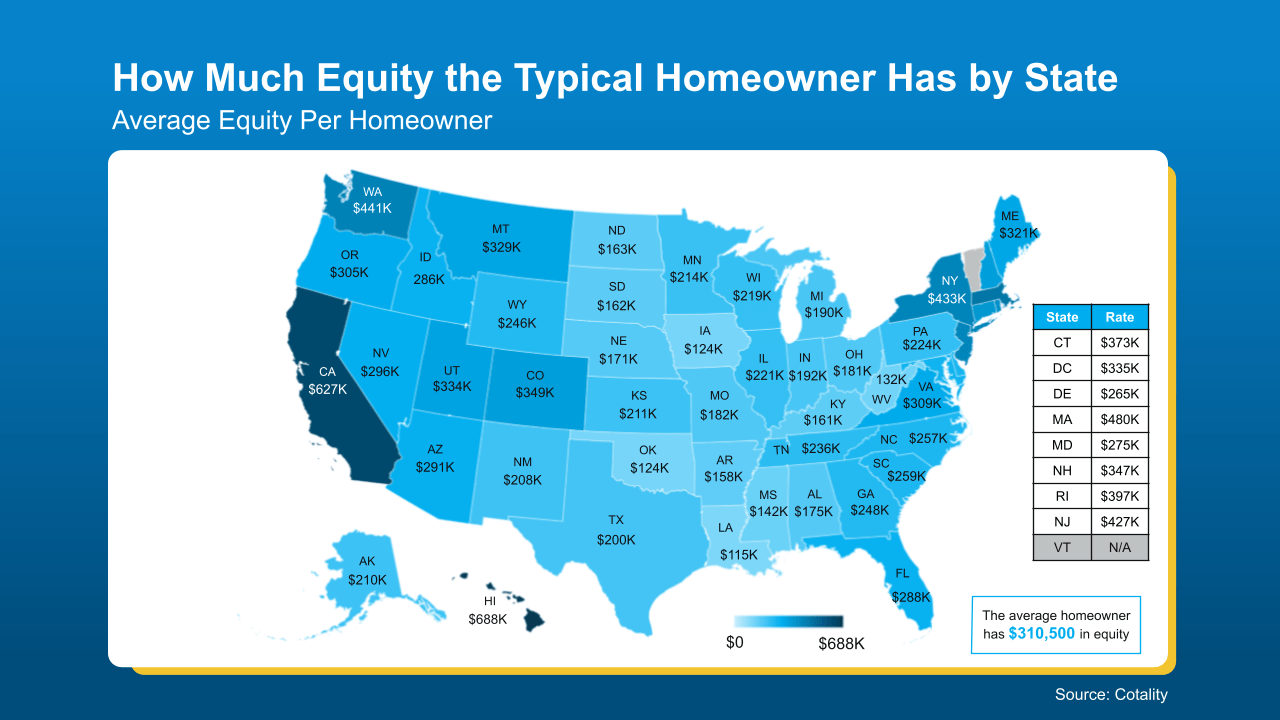
Of course, every home and every local real estate market is different. That’s why the most important question isn’t how much equity the average American homeowner has.
The question is: How much equity do you have in your home?
If you don’t know that number, you may not have a complete picture of what is financially possible.
We understand why many homeowners feel reluctant to move.
Home prices are higher than they were several years ago. Mortgage rates aren’t close to the historically low 3% rates many homeowners currently have. Giving up a low mortgage rate can be a difficult decision, and it should never be taken lightly.
But your current mortgage rate is only one part of the equation.
If you have owned your home for several years, you may not be starting your next purchase from scratch. The equity you’ve accumulated could give you a much larger down payment, reduce the amount you need to finance and completely change the monthly-payment calculation.
In other words, your next home may cost more—but you may also be bringing considerably more money to the transaction than you realize.
Whether you need more space, want a different location or are ready to downsize, your equity could help bridge the gap between the home you own today and the lifestyle you want next.
Depending on your financial circumstances, your home equity could help you:
A larger down payment means borrowing less money. With today’s mortgage rates, reducing the size of your loan can make a meaningful difference in your monthly payment.
It may also help you eliminate private mortgage insurance, strengthen your offer and make your next home more affordable over the long term.
This possibility surprises many homeowners. After years of appreciation and mortgage payments, some people have built enough equity to purchase their next home without a mortgage—especially when they are downsizing or moving to a less expensive area.
According to the National Association of Realtors, 26% of repeat buyers paid cash for their homes in July.
A cash purchase can eliminate the monthly principal-and-interest payment, remove concerns about current mortgage rates and make an offer more attractive to a seller.
Moving isn’t always the best answer.
If you love your neighborhood and location but your home no longer fits your needs, your equity may provide a way to renovate or remodel. That could mean updating the kitchen, adding a main-floor bedroom, finishing the basement or modifying the home so you can remain there comfortably for many more years.
The right improvements may make your home more enjoyable today while potentially adding value when you eventually decide to sell.
Your equity won’t eliminate every challenge in today’s market. But it could give you considerably more purchasing power, flexibility and control than you thought you had.
That’s why your home’s value shouldn’t be something you have to guess about.
If you’re considering a move—or simply want to understand your options—the best place to start is with a professional evaluation of your home’s current market value.
At the Parker Colorado Home Center, we can prepare a complimentary, personalized Home Equity Assessment showing:
What your home may reasonably sell for in today’s market
Your estimated selling expenses
Your approximate mortgage payoff
The amount of equity you may have available
How that equity could affect your next purchase
This isn’t an automated online estimate. It’s a professional evaluation based on your home, its condition, recent comparable sales and current buyer activity in your neighborhood.
Once you know the number, the question may no longer be whether you can afford to move. The better question may be: What kind of move makes the most sense for you?
If it has been a while since you’ve had a professional evaluation of your home, now may be the right time.
Contact Bob and Cheryl Bustin at the Parker Colorado Home Center for a complimentary Home Equity Assessment. We’ll help you understand what your home could sell for, how much equity you may have accumulated and what that could mean for your next move—without pressure or obligation.
If you’re planning to buy your next home, you’ve probably heard that you should put at least 20% down.
That has been the traditional rule for many years, but it isn’t a requirement for most buyers. There are several financing programs that allow qualified buyers to purchase a home with considerably less than 20% down.
Even so, many repeat buyers are choosing to put down 20% or more. According to the National Association of Realtors, the typical repeat buyer now makes a down payment of approximately 23%.
So, if they don’t have to put that much down, why are they doing it?
There are two primary reasons. First, a larger down payment can provide some significant financial advantages. Second, many longtime homeowners have accumulated enough equity in their current homes to make a 20% down payment possible.
The typical repeat buyer puts down approximately 23% when purchasing a home. That’s more than double the 10% down payment commonly made by first-time buyers.
[Insert NAR repeat-buyer down-payment graph here]
How are repeat buyers able to come up with that much money? In most cases, the answer is the equity they’ve built in their current home.
When you own a home for a number of years, two things generally happen. You gradually pay down your mortgage, and your home will hopefully increase in value. The difference between your home’s current market value and the amount you still owe is your equity.
For example, if your home is worth $700,000 and you owe $300,000 on the mortgage, you have approximately $400,000 in gross equity. Your actual proceeds would be reduced by selling expenses and other costs, but that still represents a substantial amount of purchasing power.
When you sell your home, that equity becomes cash you can use toward your next purchase. According to NAR, most repeat buyers use proceeds from the sale of their previous home as the primary source of their next down payment.
[Insert NAR down-payment source chart here]
First-time buyers haven’t had the opportunity to build that kind of equity, and that’s perfectly normal. But if you’ve owned your home for several years—especially here in Parker or the surrounding Denver metro area—you may have considerably more equity than you realize.
That equity could make buying your next home more affordable, even with today’s mortgage rates.
If you have enough equity to put 20% down, it’s certainly worth considering. Here are four of the most important benefits.
The more money you put down, the less you have to borrow.
That means a lower monthly principal-and-interest payment. With mortgage rates higher than they were several years ago, reducing the amount you finance can make a meaningful difference in your monthly expenses.
For many homeowners, this is what makes moving into their next home financially comfortable.
A smaller mortgage doesn’t just lower your monthly payment. It can also substantially reduce the total interest you pay over the life of the loan.
If you put 20% down, you’re financing 80% of the purchase price. If you put only 5% down, you’re financing 95%.
That difference can amount to tens of thousands of dollars—or considerably more—over a 30-year mortgage, depending on the home’s price and the interest rate.
When you put less than 20% down on most conventional loans, the lender will generally require private mortgage insurance, commonly known as PMI.
PMI protects the lender if the borrower defaults. It does not protect the homeowner, but the homeowner pays for it as part of the monthly mortgage payment.
Putting at least 20% down will usually eliminate the need for PMI, which can save you money every month.
A larger down payment may also strengthen your purchase offer.
From a seller’s perspective, a buyer with a substantial down payment may appear to be better qualified and less likely to encounter financing problems before closing. It can also provide some additional protection if the appraisal comes in lower than expected.
A 20% down payment won’t automatically make your offer the best one, but when a seller is comparing two otherwise similar offers, stronger financing may help yours stand out.
Not necessarily.
Putting more money down has some definite advantages, but you don’t want to use every available dollar for your down payment. It’s important to keep enough cash for closing costs, moving expenses, possible repairs or improvements, and an emergency reserve.
You should also consider whether some of your available funds would be better used to pay off higher-interest debt or remain invested elsewhere.
The right down payment depends on your finances, your comfort level, the home you’re buying, and your plans for the future. A good lender can compare several down-payment scenarios so you can see the actual difference in your monthly payment, cash requirements, and long-term interest costs.
You don’t have to put 20% down to buy your next home. Plenty of buyers successfully purchase homes with less.
But if you’ve owned your current home for several years, the equity you’ve accumulated may put a larger down payment within reach. Using some of that equity could lower your monthly payment, eliminate PMI, reduce the interest you’ll pay, and make your offer more attractive to a seller.
Before deciding, start by finding out what your current home is worth and approximately how much you would receive from the sale.
If you’re considering selling your home in Parker or one of the surrounding communities, Cheryl and I would be happy to prepare a detailed market analysis. We can help you determine how much equity you may have available and how it could be used to make your next move possible.
Most people think about buying a home because they want stability, more space, or a place that truly feels like their own. Those are all good reasons. But homeownership can also offer important long-term financial benefits.
Eric Belsky, formerly with Harvard University’s Joint Center for Housing Studies, identified five financial reasons people should consider owning a home. Although every buyer’s situation is different, these principles are still worth understanding.
For most people, a home is the only major investment they can purchase using borrowed money.
If you buy an $800,000 home with an $80,000 down payment, you control the entire property even though you initially invested only a portion of its value. If that home appreciates over time, the increase is based on the full value of the home—not simply the amount of your down payment.
Of course, leverage works both ways, and home values are never guaranteed to rise every year. But over the long term, homeownership has helped many families build substantial wealth.
Unless you own your home free and clear, you will have a monthly housing expense.
When you rent, your payment helps your landlord cover the mortgage and build equity in the property. When you own, a portion of each mortgage payment generally goes toward reducing your own loan balance.
Rent provides a place to live. A mortgage payment can provide a place to live while also helping you build ownership in a valuable asset.
Most of us know we should save more, but it is easy to put it off when other expenses come along.
A fixed-rate mortgage creates a disciplined way to build wealth. With every payment, part of the principal is paid down. Over the years, that gradually increases your equity—even if you are not especially disciplined about saving money in other ways.
It is one of the reasons so many longtime homeowners discover that their home has become one of their largest financial assets.
Depending on your personal situation, homeownership may provide certain tax advantages. Mortgage interest and property taxes may be deductible for homeowners who itemize, subject to current tax laws and applicable limits.
There may also be an exclusion on a portion of the capital gain when you sell your primary residence, provided you meet the IRS ownership and occupancy requirements.
Tax laws can change, and everyone’s circumstances are different, so it is always smart to discuss the potential benefits with a qualified tax professional.
Rents, construction costs, and home prices have historically tended to rise over time.
If you have a fixed-rate mortgage, the principal-and-interest portion of your payment remains stable even as many other costs increase. Renters, on the other hand, may face rent increases year after year.
Owning a home cannot protect you from every rising expense—property taxes, insurance, maintenance, and utilities can still increase—but it can provide more stability and control over one of your largest monthly costs.
Buying a home is not automatically the right decision for everyone. Your finances, lifestyle, future plans, and how long you expect to remain in the home should all be considered.
But if you are financially prepared and plan to stay in the area for several years, homeownership can offer much more than a roof over your head. It can help you build equity, create financial stability, and increase your long-term net worth.
After helping hundreds of families buy and sell homes throughout Parker and the surrounding communities, we have seen firsthand what homeownership can mean over time. If you are considering buying a home in Parker, Colorado, or anywhere in the southeast Denver metro area, Cheryl and I would be happy to help you look at the numbers, understand your options, and decide whether buying makes sense for you.
