When was the last time you received a professional opinion of what your home is actually worth?
We’re not talking about an estimate generated by an online valuation tool—or assuming your home is worth the same as a neighbor’s property that recently sold. We’re talking about a careful, market-based evaluation of what your particular home could sell for in today’s market.
For many homeowners, it has been years since they’ve had that conversation. And if you’ve thought about moving but higher home prices or today’s mortgage rates have caused you to hesitate, it may be time to take another look.
The number that could change everything is the amount of equity you have in your home.
Home values have increased considerably over the past five to ten years. Even though today’s real estate market is more balanced than it was a few years ago, many homeowners are still building wealth simply by owning their homes.
Equity generally grows in two ways:
Your home increases in value.
You reduce your mortgage balance through your monthly payments.
Over time, those two things can add up to a substantial amount of money.
According to Cotality, the typical homeowner with a mortgage now has approximately $310,500 in equity. That is a national average, and homeowners in some states have built considerably more.
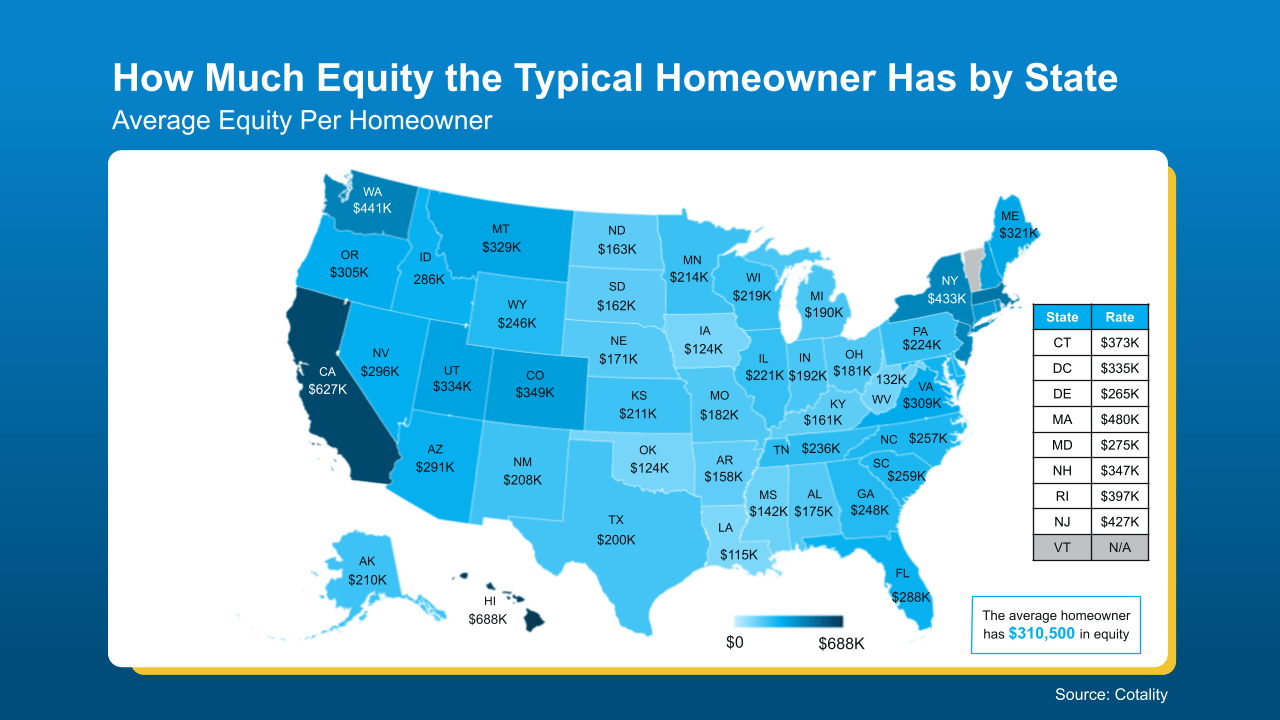
Of course, every home and every local real estate market is different. That’s why the most important question isn’t how much equity the average American homeowner has.
The question is: How much equity do you have in your home?
If you don’t know that number, you may not have a complete picture of what is financially possible.
We understand why many homeowners feel reluctant to move.
Home prices are higher than they were several years ago. Mortgage rates aren’t close to the historically low 3% rates many homeowners currently have. Giving up a low mortgage rate can be a difficult decision, and it should never be taken lightly.
But your current mortgage rate is only one part of the equation.
If you have owned your home for several years, you may not be starting your next purchase from scratch. The equity you’ve accumulated could give you a much larger down payment, reduce the amount you need to finance and completely change the monthly-payment calculation.
In other words, your next home may cost more—but you may also be bringing considerably more money to the transaction than you realize.
Whether you need more space, want a different location or are ready to downsize, your equity could help bridge the gap between the home you own today and the lifestyle you want next.
Depending on your financial circumstances, your home equity could help you:
A larger down payment means borrowing less money. With today’s mortgage rates, reducing the size of your loan can make a meaningful difference in your monthly payment.
It may also help you eliminate private mortgage insurance, strengthen your offer and make your next home more affordable over the long term.
This possibility surprises many homeowners. After years of appreciation and mortgage payments, some people have built enough equity to purchase their next home without a mortgage—especially when they are downsizing or moving to a less expensive area.
According to the National Association of Realtors, 26% of repeat buyers paid cash for their homes in July.
A cash purchase can eliminate the monthly principal-and-interest payment, remove concerns about current mortgage rates and make an offer more attractive to a seller.
Moving isn’t always the best answer.
If you love your neighborhood and location but your home no longer fits your needs, your equity may provide a way to renovate or remodel. That could mean updating the kitchen, adding a main-floor bedroom, finishing the basement or modifying the home so you can remain there comfortably for many more years.
The right improvements may make your home more enjoyable today while potentially adding value when you eventually decide to sell.
Your equity won’t eliminate every challenge in today’s market. But it could give you considerably more purchasing power, flexibility and control than you thought you had.
That’s why your home’s value shouldn’t be something you have to guess about.
If you’re considering a move—or simply want to understand your options—the best place to start is with a professional evaluation of your home’s current market value.
At the Parker Colorado Home Center, we can prepare a complimentary, personalized Home Equity Assessment showing:
What your home may reasonably sell for in today’s market
Your estimated selling expenses
Your approximate mortgage payoff
The amount of equity you may have available
How that equity could affect your next purchase
This isn’t an automated online estimate. It’s a professional evaluation based on your home, its condition, recent comparable sales and current buyer activity in your neighborhood.
Once you know the number, the question may no longer be whether you can afford to move. The better question may be: What kind of move makes the most sense for you?
If it has been a while since you’ve had a professional evaluation of your home, now may be the right time.
Contact Bob and Cheryl Bustin at the Parker Colorado Home Center for a complimentary Home Equity Assessment. We’ll help you understand what your home could sell for, how much equity you may have accumulated and what that could mean for your next move—without pressure or obligation.
If you’re planning to buy your next home, you’ve probably heard that you should put at least 20% down.
That has been the traditional rule for many years, but it isn’t a requirement for most buyers. There are several financing programs that allow qualified buyers to purchase a home with considerably less than 20% down.
Even so, many repeat buyers are choosing to put down 20% or more. According to the National Association of Realtors, the typical repeat buyer now makes a down payment of approximately 23%.
So, if they don’t have to put that much down, why are they doing it?
There are two primary reasons. First, a larger down payment can provide some significant financial advantages. Second, many longtime homeowners have accumulated enough equity in their current homes to make a 20% down payment possible.
The typical repeat buyer puts down approximately 23% when purchasing a home. That’s more than double the 10% down payment commonly made by first-time buyers.
[Insert NAR repeat-buyer down-payment graph here]
How are repeat buyers able to come up with that much money? In most cases, the answer is the equity they’ve built in their current home.
When you own a home for a number of years, two things generally happen. You gradually pay down your mortgage, and your home will hopefully increase in value. The difference between your home’s current market value and the amount you still owe is your equity.
For example, if your home is worth $700,000 and you owe $300,000 on the mortgage, you have approximately $400,000 in gross equity. Your actual proceeds would be reduced by selling expenses and other costs, but that still represents a substantial amount of purchasing power.
When you sell your home, that equity becomes cash you can use toward your next purchase. According to NAR, most repeat buyers use proceeds from the sale of their previous home as the primary source of their next down payment.
[Insert NAR down-payment source chart here]
First-time buyers haven’t had the opportunity to build that kind of equity, and that’s perfectly normal. But if you’ve owned your home for several years—especially here in Parker or the surrounding Denver metro area—you may have considerably more equity than you realize.
That equity could make buying your next home more affordable, even with today’s mortgage rates.
If you have enough equity to put 20% down, it’s certainly worth considering. Here are four of the most important benefits.
The more money you put down, the less you have to borrow.
That means a lower monthly principal-and-interest payment. With mortgage rates higher than they were several years ago, reducing the amount you finance can make a meaningful difference in your monthly expenses.
For many homeowners, this is what makes moving into their next home financially comfortable.
A smaller mortgage doesn’t just lower your monthly payment. It can also substantially reduce the total interest you pay over the life of the loan.
If you put 20% down, you’re financing 80% of the purchase price. If you put only 5% down, you’re financing 95%.
That difference can amount to tens of thousands of dollars—or considerably more—over a 30-year mortgage, depending on the home’s price and the interest rate.
When you put less than 20% down on most conventional loans, the lender will generally require private mortgage insurance, commonly known as PMI.
PMI protects the lender if the borrower defaults. It does not protect the homeowner, but the homeowner pays for it as part of the monthly mortgage payment.
Putting at least 20% down will usually eliminate the need for PMI, which can save you money every month.
A larger down payment may also strengthen your purchase offer.
From a seller’s perspective, a buyer with a substantial down payment may appear to be better qualified and less likely to encounter financing problems before closing. It can also provide some additional protection if the appraisal comes in lower than expected.
A 20% down payment won’t automatically make your offer the best one, but when a seller is comparing two otherwise similar offers, stronger financing may help yours stand out.
Not necessarily.
Putting more money down has some definite advantages, but you don’t want to use every available dollar for your down payment. It’s important to keep enough cash for closing costs, moving expenses, possible repairs or improvements, and an emergency reserve.
You should also consider whether some of your available funds would be better used to pay off higher-interest debt or remain invested elsewhere.
The right down payment depends on your finances, your comfort level, the home you’re buying, and your plans for the future. A good lender can compare several down-payment scenarios so you can see the actual difference in your monthly payment, cash requirements, and long-term interest costs.
You don’t have to put 20% down to buy your next home. Plenty of buyers successfully purchase homes with less.
But if you’ve owned your current home for several years, the equity you’ve accumulated may put a larger down payment within reach. Using some of that equity could lower your monthly payment, eliminate PMI, reduce the interest you’ll pay, and make your offer more attractive to a seller.
Before deciding, start by finding out what your current home is worth and approximately how much you would receive from the sale.
If you’re considering selling your home in Parker or one of the surrounding communities, Cheryl and I would be happy to prepare a detailed market analysis. We can help you determine how much equity you may have available and how it could be used to make your next move possible.
Most people think about buying a home because they want stability, more space, or a place that truly feels like their own. Those are all good reasons. But homeownership can also offer important long-term financial benefits.
Eric Belsky, formerly with Harvard University’s Joint Center for Housing Studies, identified five financial reasons people should consider owning a home. Although every buyer’s situation is different, these principles are still worth understanding.
For most people, a home is the only major investment they can purchase using borrowed money.
If you buy an $800,000 home with an $80,000 down payment, you control the entire property even though you initially invested only a portion of its value. If that home appreciates over time, the increase is based on the full value of the home—not simply the amount of your down payment.
Of course, leverage works both ways, and home values are never guaranteed to rise every year. But over the long term, homeownership has helped many families build substantial wealth.
Unless you own your home free and clear, you will have a monthly housing expense.
When you rent, your payment helps your landlord cover the mortgage and build equity in the property. When you own, a portion of each mortgage payment generally goes toward reducing your own loan balance.
Rent provides a place to live. A mortgage payment can provide a place to live while also helping you build ownership in a valuable asset.
Most of us know we should save more, but it is easy to put it off when other expenses come along.
A fixed-rate mortgage creates a disciplined way to build wealth. With every payment, part of the principal is paid down. Over the years, that gradually increases your equity—even if you are not especially disciplined about saving money in other ways.
It is one of the reasons so many longtime homeowners discover that their home has become one of their largest financial assets.
Depending on your personal situation, homeownership may provide certain tax advantages. Mortgage interest and property taxes may be deductible for homeowners who itemize, subject to current tax laws and applicable limits.
There may also be an exclusion on a portion of the capital gain when you sell your primary residence, provided you meet the IRS ownership and occupancy requirements.
Tax laws can change, and everyone’s circumstances are different, so it is always smart to discuss the potential benefits with a qualified tax professional.
Rents, construction costs, and home prices have historically tended to rise over time.
If you have a fixed-rate mortgage, the principal-and-interest portion of your payment remains stable even as many other costs increase. Renters, on the other hand, may face rent increases year after year.
Owning a home cannot protect you from every rising expense—property taxes, insurance, maintenance, and utilities can still increase—but it can provide more stability and control over one of your largest monthly costs.
Buying a home is not automatically the right decision for everyone. Your finances, lifestyle, future plans, and how long you expect to remain in the home should all be considered.
But if you are financially prepared and plan to stay in the area for several years, homeownership can offer much more than a roof over your head. It can help you build equity, create financial stability, and increase your long-term net worth.
After helping hundreds of families buy and sell homes throughout Parker and the surrounding communities, we have seen firsthand what homeownership can mean over time. If you are considering buying a home in Parker, Colorado, or anywhere in the southeast Denver metro area, Cheryl and I would be happy to help you look at the numbers, understand your options, and decide whether buying makes sense for you.
If you’re thinking about buying a home but have decided to wait for mortgage rates to come down, you’re certainly not alone.
Many home buyers here in Parker, Colorado believe substantially lower rates are just around the corner. But imagine waiting another year, only to discover that rates haven’t changed very much—and home prices have continued to rise.
That is a real possibility.
No one can predict mortgage rates with complete certainty. But based on current forecasts, buyers waiting for a dramatic drop may be waiting much longer than they expect.
Before you put your plans on hold, let’s look at what the experts are projecting and some options that may help you make a move—even if rates don’t fall significantly.
A recent Clever–Best Interest survey found that 42% of people believe mortgage rates will fall below 5% this year.
Unfortunately, that isn’t what most housing and mortgage experts are forecasting.
Current projections from Fannie Mae, the Mortgage Bankers Association, and Wells Fargo generally show mortgage rates remaining in the low-to-mid 6% range through at least the middle of 2027.
[Insert mortgage-rate forecast graph here]
Mortgage rates are influenced by inflation, Treasury yields, Federal Reserve policy, the strength of the economy, employment data, and even global events. Right now, those factors do not point toward the kind of dramatic decline many buyers are hoping to see.
Could rates move up or down along the way? Absolutely. But if you’re waiting for rates to fall into the 4% range—or even below 5%—today’s forecasts suggest you could remain on the sidelines for quite some time.
Inflation is another important piece of the puzzle. Generally speaking, persistent inflation makes it more difficult for mortgage rates to fall substantially.
After remaining relatively stable from the middle of 2023 through late 2025, recent data shows inflation has started trending higher again.
[Insert inflation graph here]
That matters because one of the conditions usually needed for significantly lower mortgage rates simply isn’t in place right now.
Until inflation shows a clear and sustained decline, mortgage rates may remain close to where they are today.
This may require the biggest adjustment in expectations.
Today’s mortgage rates feel high because many of us remember the exceptionally low rates available during the pandemic. Some homeowners were able to lock in rates around 3%, and occasionally even lower.
But those rates were not normal. They resulted from a very unusual set of economic circumstances.
Historically, mortgage rates have spent much of their time between approximately 5% and 10%. Freddie Mac’s long-term data shows that today’s rates fall well within that historical range.
[Insert historical mortgage-rate graph here]
That doesn’t mean a mortgage rate in the 6% range is especially attractive. It simply means waiting for pandemic-level rates to return may not be a realistic homebuying strategy.
None of this means you should buy a home before you’re financially and personally ready. You shouldn’t.
But if your family, job, retirement plans, or changing lifestyle are creating a reason to move, there may be ways to improve affordability without waiting indefinitely for mortgage rates to fall.
Many builders are offering incentives to attract buyers. Depending on the community and builder, those incentives may include mortgage-rate buydowns, closing-cost assistance, price reductions, or upgraded features.
In some cases, the builder’s financing incentives can make a new home more affordable than a similarly priced resale property.
An adjustable-rate mortgage, commonly called an ARM, may offer a lower introductory rate than a traditional 30-year fixed-rate mortgage.
An ARM is not appropriate for everyone. But if you expect to move, refinance, or pay off the loan before the adjustable period begins, it may be worth discussing with a qualified lender.
Be sure you understand when the rate can adjust, how much it can increase, and whether you could comfortably afford the higher payment.
A mortgage-rate buydown uses money paid upfront to reduce your interest rate and monthly payment. The cost may be paid by you, negotiated as a seller concession, or offered as an incentive by a homebuilder.
Depending on the property and the terms of the transaction, a buydown could make more financial sense than waiting and hoping rates eventually decline.
Some government-backed FHA, VA, and USDA mortgages may be assumable. That means a qualified buyer may be able to take over the seller’s existing loan—including its lower interest rate.
Assumable loans can be an excellent opportunity, but they also come with qualification requirements and logistical challenges. The buyer may need substantial cash or secondary financing to cover the difference between the seller’s loan balance and the purchase price.
It’s easy to focus entirely on the mortgage rate and overlook what could happen while you wait.
If rates remain relatively steady but Parker-area home prices increase, the home you want could cost more a year from now. You may also miss opportunities to negotiate with sellers, receive closing-cost assistance, or take advantage of builder incentives available in today’s market.
The goal isn’t to perfectly time the market. Very few people can do that.
The goal is to understand your options, look at the complete financial picture, and decide whether buying now or waiting puts you in the best long-term position.
If you’ve put your home search on hold because you’re convinced mortgage rates will be substantially lower soon, it may be time to take another look at that strategy.
You don’t have to buy today. But you also shouldn’t assume waiting is your only—or best—option.
Cheryl and I have spent decades helping buyers throughout Parker, Castle Rock, Franktown, Elizabeth, Highlands Ranch, Centennial, and the surrounding communities. We can help you explore available homes, builder incentives, assumable mortgages, and other opportunities—without pressure and without trying to talk you into a decision that isn’t right for you.
Let’s talk about what you’re hoping to accomplish. Together with a trusted lender, we can help you compare the numbers and determine whether waiting truly improves your position—or simply keeps you on the sidelines longer.
If you’re planning to sell your current home and purchase another one, one of the first decisions you’ll face is which should happen first:
Should you buy your next home before selling—or sell your current home before you begin making offers?
There isn’t one answer that works for everyone. The right strategy depends on your finances, available equity, timing, and current market conditions. Here in Parker and across the Denver metro area, the price ranges and neighborhoods involved can also make a significant difference.
However, in today’s market, many homeowners may be in a stronger and less stressful position if they sell first.
Selling is often the less predictable part of the process. With buyers having more homes to choose from, some properties are taking longer to sell than they did during the unusually competitive markets of a few years ago.
Once your home is sold—or at least securely under contract—you’ve removed one of the biggest uncertainties from your move.
Here are three important advantages.
Buying your next home before selling your current one can leave you responsible for two mortgage payments, two insurance policies, two sets of utility bills, and the upkeep on two properties.
That may be manageable for a short time, but what happens if your current home takes longer to sell than anticipated? A few extra months of overlapping expenses can quickly become costly. Unexpected repairs or price reductions can add even more financial pressure.
Selling first eliminates much of that risk. You’ll know your current home has sold before committing to the ongoing expenses of another property.
For many homeowners, the equity in their current house will provide most or all of the down payment for their next home.
Your equity is the difference between your home’s market value and the amount you still owe on it. Depending on how long you’ve owned your home—and how much property values have increased—you may have considerably more equity than you realize.
Selling first gives you a clear picture of your net proceeds after paying off the mortgage and covering selling expenses. You’ll then know exactly how much you can use toward:
The down payment on your next home
Closing costs
Moving expenses
Repairs or improvements
A lower mortgage balance
Possibly purchasing your next home with cash
Having firm numbers makes it much easier to establish a comfortable price range and avoid stretching your finances too far.
An offer that depends on selling another property is called a contingent offer. While these offers are common, they introduce additional uncertainty for the seller.
If your current home has already sold, you may be able to make an offer without a home-sale contingency. That can make your offer more attractive—even if it isn’t the highest offer the seller receives.
Put yourself in the seller’s position. If their home has been on the market for a while, they’re likely to favor an offer with fewer complications and a greater likelihood of closing.
A strong, non-contingent offer may also give you additional negotiating power. Depending on the property and market conditions, you may be able to request repairs, closing-cost assistance, a rate buydown, or other favorable terms.
That’s the biggest concern most homeowners have—and it’s a reasonable one.
Nobody wants to sell their home and suddenly feel rushed into purchasing another property that isn’t right for them. Fortunately, there are several ways we can help reduce that risk.
One option is negotiating a post-closing occupancy agreement, sometimes called a rent-back. This allows you to remain in your current home for an agreed-upon period after the sale closes.
Other possibilities include:
Coordinating an extended closing
Negotiating flexible possession dates
Arranging temporary housing
Storing some belongings during the transition
Beginning your home search before your property is officially listed
Preparing backup plans before accepting an offer
The key is to think through these possibilities before putting your home on the market. A well-planned timeline can make the transition far easier.
Absolutely. Buying first may make sense if:
You can comfortably afford two mortgages
You have enough cash for a down payment without selling
You’re purchasing in an area with very limited inventory
You’ve found a home that would be difficult to replace
Your current property is expected to sell quickly
You qualify for bridge financing or another appropriate financial option
The important thing is to understand the financial risks and have a realistic plan if your existing home doesn’t sell as quickly—or for as much—as expected.
The best approach may be different for every homeowner. Selling a home in The Timbers, Pradera, The Pinery, Stonegate, or another Parker-area neighborhood involves different price points, buyer pools, competition, and expected marketing times.
The market for the home you’re selling may also be very different from the market for the one you hope to buy. You could be selling in a price range with slower activity while purchasing in one where desirable homes still receive multiple offers.
That’s why we evaluate both sides of the move before recommending a strategy.
There is no one-size-fits-all answer when you’re selling and buying a home at the same time. However, for many Parker-area homeowners, selling first provides greater financial clarity, a stronger position when making an offer, and less risk of carrying two homes.
The best time to start planning is before your home goes on the market. We can help you estimate its likely selling price, calculate your potential proceeds, review the competition, and create a practical plan for purchasing your next home.
Bob and I have lived in Parker since 1987, and we understand both the local housing market and the stress that can come with coordinating two transactions. Our job is to anticipate the potential problems, explain your options honestly, and make the transition as smooth as possible.
If you’re considering selling and buying in Parker, Castle Rock, Franktown, Elizabeth, Highlands Ranch, Centennial, Aurora, or elsewhere in the Denver metro area, let’s sit down and talk through the best strategy for your situation.

If buying a home here in Parker, Colorado is on your radar, you've probably been keeping an eye on mortgage rates and home prices. But don’t forget about homeowners insurance.
Homeowners insurance has always been part of owning a home. But over the past few years, it's become a larger expense for many homeowners – something that's especially frustrating when affordability already feels tight.
The good news? While premiums are still rising, the latest data shows those increases are beginning to slow. Here's what buyers should know.
You've probably heard stories from friends or family about their premiums going up. And that’s not really a surprise when you consider data from the Pew Research Center shows 71% of homeowners say their insurance costs have gone up over the past few years.
While no one likes rising costs, knowing what to expect can help you plan ahead. Your first insurance payment is typically included in your closing costs, but after that it'll become part of your monthly housing expenses.
Getting an insurance quote early can help you build a more realistic budget and avoid surprises later.
Most of the headlines focus on how home insurance is getting more expensive. And that's true. But here’s the part that’s easy to miss.
Insurance premiums are still rising.
But they're not rising as fast as they were.
According to the latest report from Rate Insurance, 2025 saw the first slowdown in annual premium increases since 2019 (see graph below):
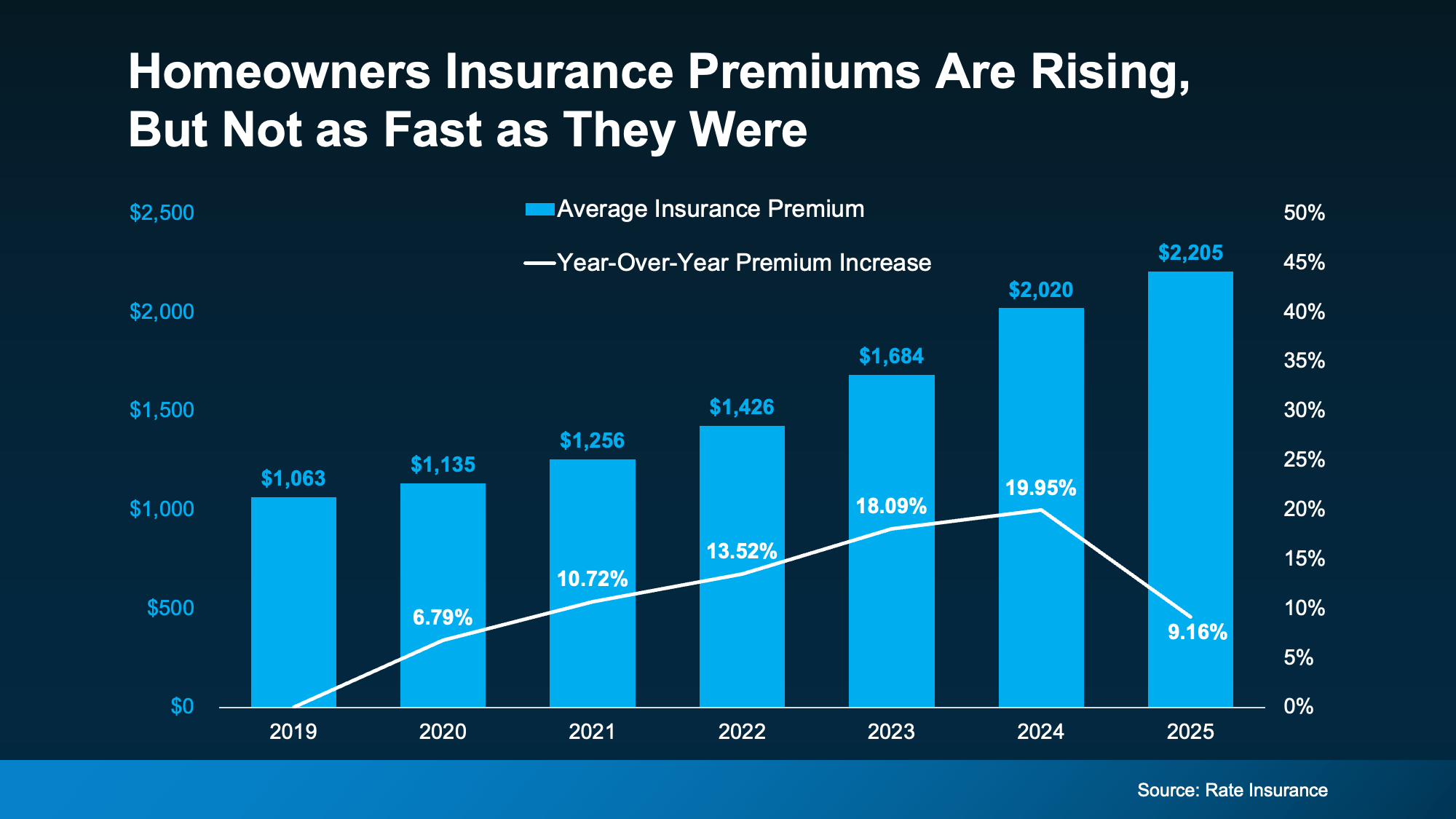
That doesn't mean premiums are getting cheaper. It simply means the rapid increases of the past several years may finally be starting to ease – a small but welcome step in the right direction.
But what you’ll pay in one part of the country can look very different from what someone pays somewhere else.
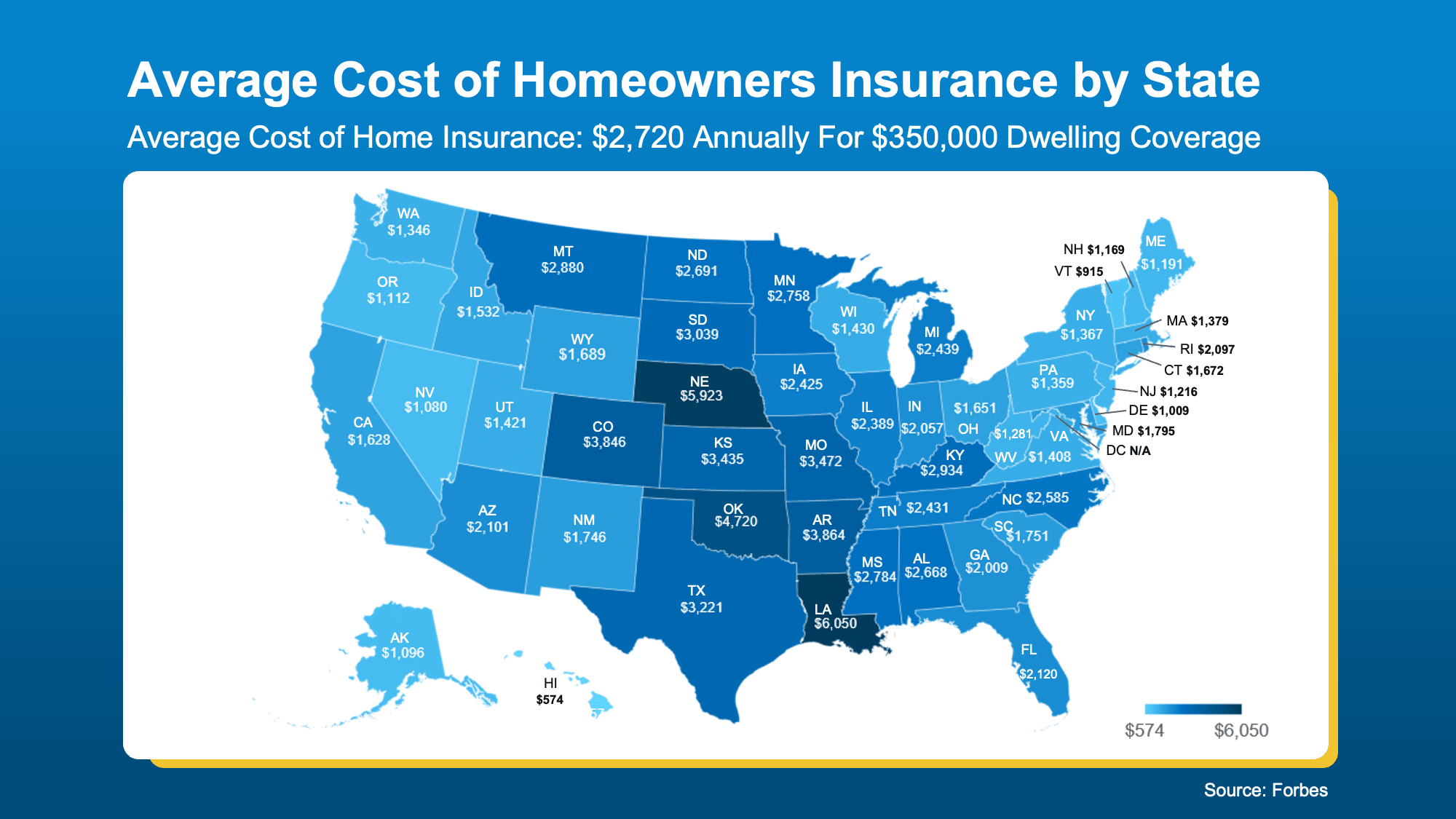
Insurance costs vary because some parts of the country experience more claims than others. That's why it's important to look at what's happening locally.
Your premium will depend on things like where you're buying, the home itself, and the coverage you choose.
Forbes data can give a rough idea of your state’s typical premiums. Check out the map below – the darker the blue, the higher the costs tend to be in that state:
While you can't control every cost that comes with buying a home, you can control how prepared you are. If you’re crunching the numbers and trying to find ways to save, Insurify and NerdWallet offer these tips that can help you get the best insurance price possible:
Shop Around – Compare quotes from multiple companies.
Bundle Policies – Combine home and auto to see if a bundle price is cheaper.
Ask If There Are Discounts – Don’t miss out on savings you may qualify for.
Highlight Upgrades – Features like a new roof or storm windows can cut costs.
Improve Your Credit – A stronger credit score can mean better premiums.
One of the smartest things you can do is get an insurance quote before you make an offer. That way, you'll know what your monthly housing costs are likely to be before you commit.
An insurance professional can walk you through your options and help you find coverage that fits both your needs and your budget.
Homeowners insurance has become a bigger part of the homebuying conversation. But it doesn't have to become a bigger source of stress.
The key is knowing what to expect before you buy. Get an insurance quote early, factor it into your budget, and lean on trusted local professionals to help you make the most informed decision possible.
